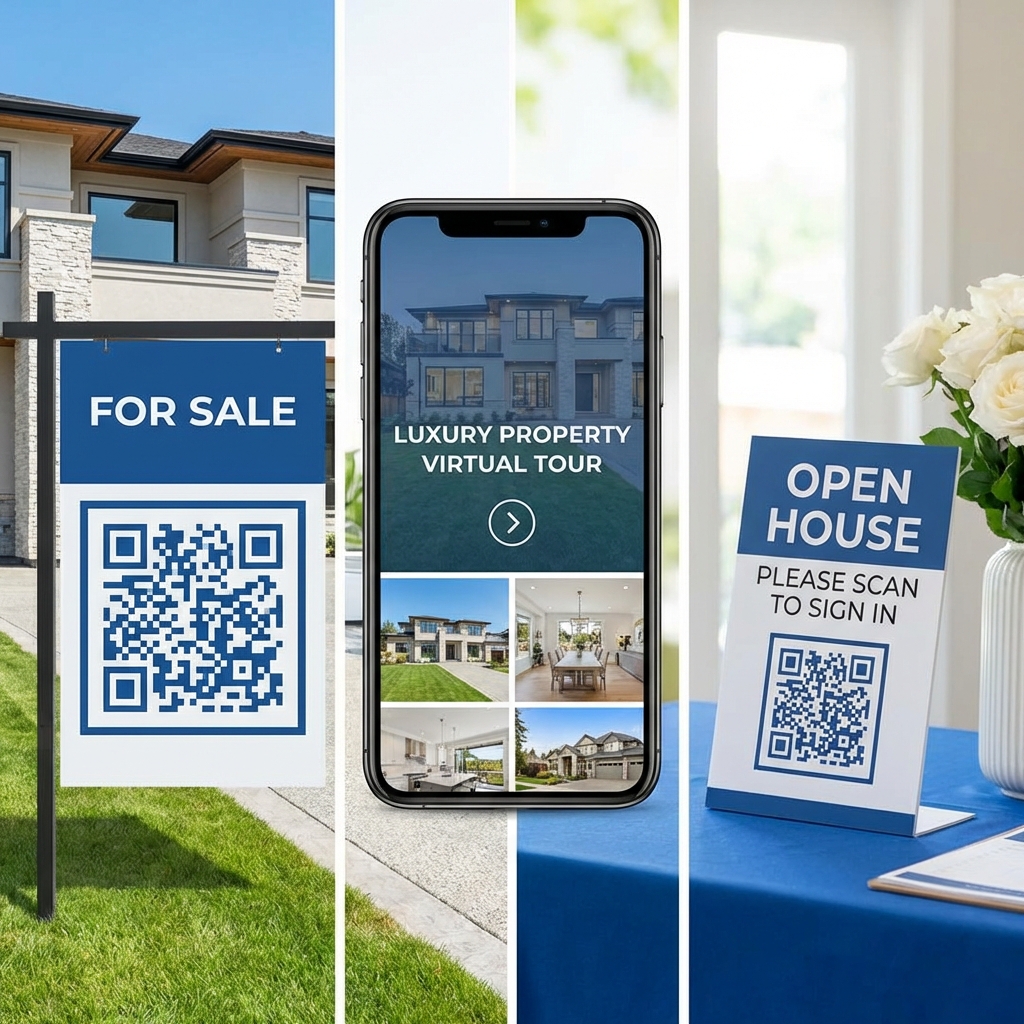
Why Real Estate Agents Need QR Codes in 2026
A buyer drives past a property. They have approximately 90 seconds of motivated curiosity before they pull away and the moment is gone. If they have to remember a website address, search an agent's name, or call a number they saw on a sign post, most of them will not follow through.
A QR code on the yard sign converts that 90-second window into an instant lead. The buyer scans, the listing opens on their phone, and your contact details are already in the pop-up. You capture the enquiry before they have even left the kerb.
Here is a complete breakdown of every high-value use case - from yard signs to open house sign-ins to vCard business cards - and exactly how to implement each one for free.
1. The Yard Sign Virtual Tour Rider
The yard sign rider is the highest-ROI placement in real estate QR marketing. A rider is the small supplementary board clipped above or below your main "For Sale" sign. Print a QR code on it with the label "Scan for Photos + Virtual Tour."
- Link it to: Your Zillow listing, Realtor.com page, a Matterport 3D tour, a YouTube video walkthrough, or a dedicated property microsite.
- Size requirement: The rider QR code must be at least 13cm × 13cm (5 inches) to be scannable from a car at the kerb - roughly 3 metres away. Download as SVG for a print-sharp result at any size.
- Pro tip: Use a URL shortener with click tracking (like Bit.ly or your CRM's built-in shortener) as the destination link, then wrap it in the QR code. You will see exactly how many drive-by scans each listing receives.
2. Open House: Digital Sign-In Sheet
Paper sign-in sheets create two problems: illegible handwriting and manual data entry. A QR code at the entrance replaces both with immediate, structured digital leads.
- Create a Google Form (free) with fields for Name, Phone Number, Email, and an optional "Are you currently working with a buyer's agent?" question for qualification.
- Copy the form's share link.
- Generate a URL QR code from that link.
- Print and frame it at the entrance: "Welcome. Please scan to sign in - it takes 30 seconds."
Google Forms automatically creates a spreadsheet of all responses. Export it as a CSV into your CRM at the end of the open house. No transcription errors, no unreadable phone numbers.
Upgrade: For higher-end listings, add a second QR code at the exit labelled "Scan to Schedule a Private Viewing" - linking to your Calendly or booking page. Motivated buyers who attended the open house are the most likely to self-schedule immediately afterwards.
3. Property Flyers with Embedded QR Codes
A single-page property flyer has limited space. A QR code embedded in the corner expands that page to unlimited content - all the photography, floor plans, history, and school catchment information that never fits on one sheet of paper.
- Design rule: The QR code should appear in the bottom-right corner with a clear label: "Scan for 40+ photos, floor plan, and virtual tour." The call to action increases scan rates significantly over unlabelled codes.
- Link target: A dedicated property website (many real estate CRM platforms generate these automatically per listing) or a Google Drive folder containing the full photo gallery and PDF floor plan.
- At flyer boxes: Add a waterproof QR code sticker to your roadside flyer box. When the box is empty, buyers can still access everything digitally.
4. vCard Business Card with QR Code
Physical business cards get left behind, lost in pockets, or thrown away. A vCard QR code saves your complete contact profile - name, agency, phone, email, headshot, and website - directly into the buyer's phone contacts in a single scan.
- Use our free vCard QR code generator.
- Fill in your full professional details including your agency brand colour (for the code design).
- Download as SVG and send to your card printer - or add the QR code to the back of your existing business card design.
Buyers who scan your vCard at an open house are far more likely to call you than those who receive only a paper card, because your number is already pre-loaded in their contacts.
5. Location QR Codes for New Developments
For off-plan or new build developments without a physical address yet, a location QR code embedded in Google Maps coordinates gives buyers turn-by-turn directions to the site directly from the development's marketing collateral. Add it to site hoardings, brochures, and online ads.
What to Link Your Real Estate QR Codes To
| Placement | Ideal Link Target | Why |
|---|---|---|
| Yard sign rider | Matterport 3D tour or full listing page | Highest-intent buyers want instant immersion |
| Property flyer | Full photo gallery + floor plan PDF | Paper flyer cannot hold 40+ photos |
| Open house entrance | Google Form sign-in | Structured leads, no transcription errors |
| Open house exit | Calendly booking page | Converts warm prospects to booked viewings immediately |
| Business card | vCard QR code (contact save) | Bypasses lost-card problem entirely |
| Development hoarding | Location QR (Google Maps) | Gives turn-by-turn directions from anywhere |
Print and Technical Requirements for Agents
- Always download SVG, not PNG: Yard signs are printed at large format. A PNG will pixelate and may fail to scan. SVG scales to any size without quality loss. See our SVG vs PNG guide.
- Test on both iOS and Android before the sign is installed: The native camera apps render QR scanning differently. An iPhone running iOS 11+ and a recent Android device cover 97%+ of your buyer pool.
- Maintain the quiet zone: The white border around a QR code - called the quiet zone - must be at least 4 modules wide on all four sides when printed. Designs that clip the border cause scan failures.
- Choose high contrast: Black modules on white background is the most reliable. If you add a brand colour, ensure luminance contrast is at least 4:1 (dark module on light background).
Why Static QR Codes Beat Dynamic Codes for Property Marketing
Dynamic QR code services (Bitly QR, QR Tiger, etc.) offer redirect-based codes that can be updated after printing. They charge $15-$40/month and have a critical flaw for real estate: if you cancel the subscription, every QR code on every printed sign, flyer, and business card you have ever distributed stops working instantly.
A static QR code has the destination URL permanently encoded in the pattern itself. There is no intermediary server. The code works indefinitely - even if you change jobs, change agencies, or stop using this generator entirely. For a listing that will sell in 30-90 days, a static code is always the right choice.